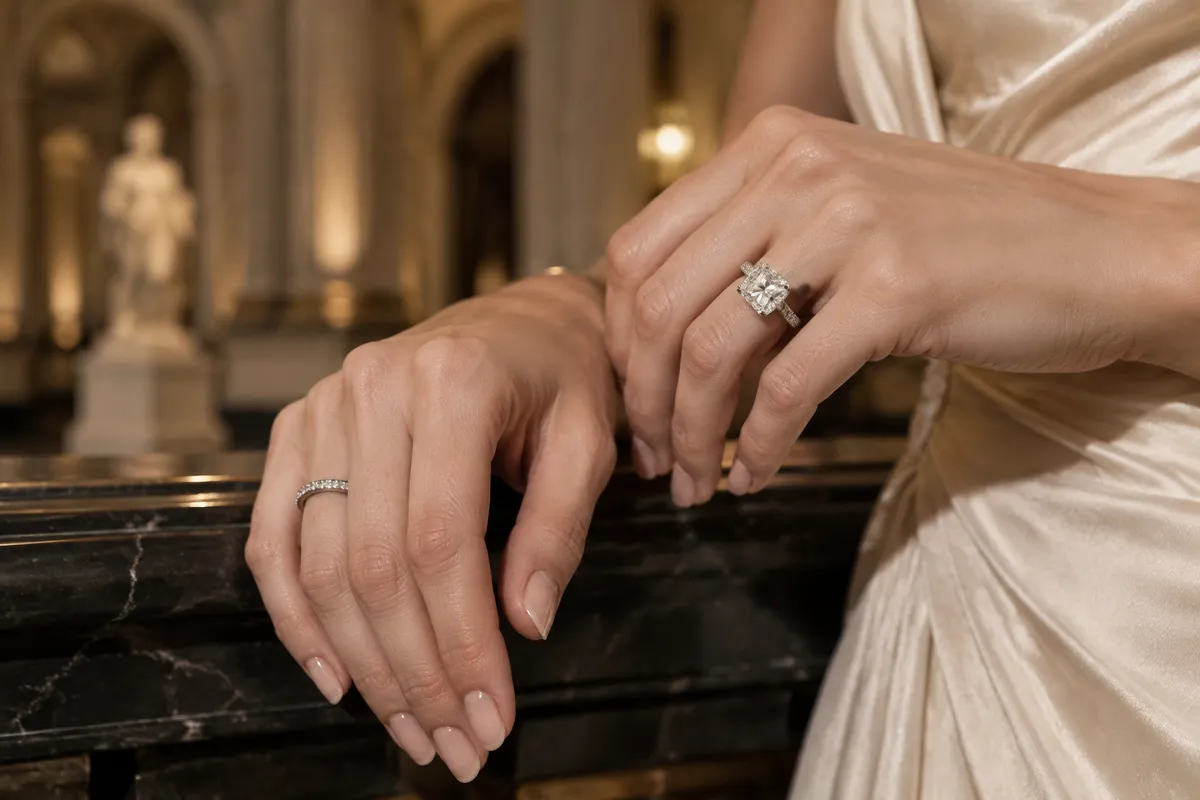
Taylor Swift just gave the public its clearest look yet at her wedding band. At the Academy Museum Gala, per Elle, she wore the band on her left hand and moved her old mine cushion-cut engagement ring over to her right.
That's a small shift with a lot of ring-nerd energy. Swift and Travis Kelce's wedding details remain closely scrutinized, and this is the first time the band has been seen on its own, no engagement ring stacked beside it.
The Move: Two Rings, Two Hands
A wedding stack usually works like a duet: engagement ring and band sharing one finger, each making the other look better. Swift's gala look turned it into a split set. The band stayed on the traditional left hand, and the engagement ring went to the right.
Elle's reporting doesn't say why she made the change, and neither will I pretend to know. But it's fair to wonder whether practicality played a role. A big stone and a band sitting flush against each other can be a lot to live with, and the Elle piece floats the idea that Swift may have separated the rings for a guitar performance. That's speculation, not confirmation. Still, it fits a trend the story points to: rising interest in practical, mix-and-match bridal jewelry.
What Jewelers Say About the Band
Elle consulted jewelers who broke down the band's design, proportions and bezel setting, and how it pairs with the mine cushion-cut engagement ring. A few things to take from that:
- Bezel setting: The stones are encased in metal rather than held up by prongs. Bezel-set pieces tend to read as sleek and low-profile, which is exactly why they're a natural fit for everyday wear. (That's my read on bezels generally, not a claim from the jewelers.)
- Proportions: The band is designed to complement the engagement ring rather than compete with it. The old mine cushion cut is the star, and the band plays a supporting role.
- Solo power: Worn alone, the band has to hold up without its partner. Elle's analysis suggests it does.
Why the Solo Band Is the Real Story
Celebrity engagement rings get the headlines. Bands usually get a footnote. Swift flipping that script by wearing the band alone is a quiet reminder that the less flashy ring may be the one doing the most work.
It also suggests a useful way to shop. If a band only looks good next to the engagement ring, you've bought half a look. If it can walk into a gala by itself, you've bought something flexible.
Borrowing the Idea Without the Budget
You don't need a famous ring to copy the logic. A few takeaways:
- Pick a band that can stand alone. Test it by itself before you test it beside the engagement ring.
- Keep proportions balanced. The band shouldn't overpower the center stone.
- Consider a bezel setting. It's a sleeker, more snag-resistant look, and Swift's band suggests it's having a moment. Whether it becomes the next big bridal trend is my guess, not a certainty.
- Allow yourself to separate the set. Moving a ring to the other hand is free, and for busy days it may be the most practical styling trick of all.
The Takeaway
Swift's gala look isn't a dramatic reinvention. It's a tiny rearrangement: one ring moved, one band finally getting its own moment. And in a world where everyone is decoding every detail of the Swift-Kelce wedding, that tiny rearrangement may say the most. The sparkle isn't going anywhere, but it's allowed to be a little more flexible.